Saturday, December 21, 2013

Small Wild Goose Pagoda 小雁塔


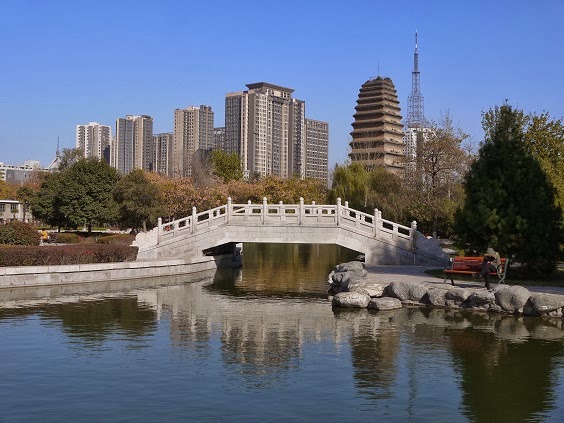
Located on the same street as us is another pagoda in Xi'an. It's just 3 bus stops away and a lot less tourist than the Big Goose Pagoda.  It was built in 707-709 during the Tang Dynasty. The pagoda stood 45 m (147 ft) until the 1556 Shaanxi earthquake. The earthquake shook the pagoda and damaged it so that it now stands at a height of 43 m (141 ft) with fifteen levels of tiers. Its also a Buddhist pagoda like the Big Goose.

We really enjoyed our time visiting this one. We went on an absolutely beautiful day, as you can see from the pictures.  It stands right next to the Xi'an Museum which we will be visiting on one of these cold polluted winter days.


Yellow found some Terracotta warriors to join.


Friday, December 20, 2013

Big Wild Goose Pagoda 大雁塔

 
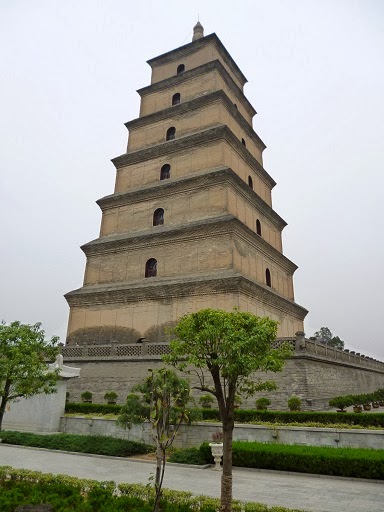
Here in Xi'an one of the main tourist attraction is the Big Wild Goose Pagoda.  We actually went there the first night during the first time that we visited Xi'an. We went that night to see the fountain and light show which is claimed to be the biggest one of its kind in Asia.  China and America share the love of making these kinds of statements. For example, the library at our university is also claimed to be the biggest library in Asia (the building not its book collection). Where in America we love to say things like "World's best cup of coffee!"

This Buddhist pagoda was originally built in 652 during the Tang Dynasty to house the Buddhist sutras that were brought by monk Xuan Zang after his 17 year trip to India through the Silk Road.  His travels inspired the best-known work of Chinese Literature, Journey to the West. We have included a map of his crazy journey. Chang'An is the ancient name of Xi'an, which was the end of the Silk Road.


Wednesday, December 4, 2013

Yáng ròu pào mó 洋肉泡馍

We haven't posted much about food, so today we will introduce you to the dish "flat bread soaked in lamb soup."

Visitors coming to Xian must do two things: check out the Terracotta warriors and horses… and eat some Yang Rou Pao Mo. But before eating, you will have some work to do. You will first be served one or two pieces of flat bread which you will break into tiny chunks, the smaller the better. The waiter or the waitress will then hand your bowl to the cook who will add the delicious lamb soup to the bread tiny chunks, without forgetting some pieces of lamb meat. When the steaming hot bread soup is handed back to you, the waiter will also offer you some sweet crisp pickled garlic, cilantro, and chili sauce. There you go, now you can enjoy.  Pao Mo (it can also be made with beef soup, in which case it is called牛肉泡馍 [Niúròu pào mó]) is a specialty of Shaanxi cuisine and a typical dish of Xi'an.

One legend about its origin says that a young man, Zhao Kuangyin (赵匡胤), who later became an emperor of the Song Dynasty, was returning home after spending some time with his fiancée. He had spent all his food and money on the journey, and he only had two pieces of inedible hard bread left. His companions entered a shop selling some lamb soup; they broke the bread in pieces and added it to the soup.

When he became emperor, he returned to the small shop and asked the cook to make the same soup again. After the meal, the emperor could not hide his joy and gave it the name羊肉 泡 馍. The rest is history… and mostly some good food that you can enjoy while visiting us in Xi’an.

Here are some pics from our first experience eating this dish when our friend Yuri and her husband came to visit us.


Friday, November 29, 2013

Beijing Opera 京剧

We had the chance to see Beijing Opera with Yellow's Chinese class. We weren't quite sure what to expect, and let's just say that it is definitely different from the usual western opera experience.  There are many similarities of course in that it involves costumes, music, dance, and vocals. However, you have to make some adjustments upon entering the venue. First of all, the colors are so extremely bright that your eyes need a minute to adjust. Then the sound of the music and the singing at first are quite jolting as the keys are different than what we are accustomed to, but after a few minutes your ears get used to it and its quite nice.
 
It arose in the late 18th century and became fully developed and recognized by the mid-19th century. It  was extremely popular in the Qing Dynasty court and has come to be regarded as one of the cultural treasures of China.
 
They had subtitled the words in Chinese characters on the sides of the stage. Yellow was trying to follow along, but it was way to fast. It was fine though because the storyline was very understandable through their actions, and we got most of it. Our favorite part of the performance was their facial expressions, which were so great. You can catch a few of them from the pictures below.


Tuesday, November 26, 2013

Ding Jitang's Woodcut Prints

While wandering through the Muslim Market we came across some beautiful pieces of peasant art. The artist, Ding Jitang, is from Chenggu, China which is another city in the Shaanxi Province.
 
In 1956 he started painting in Huxian County, the birthplace of peasant painting in China, and has brought up many other artists there.  It's just about an hour from Xi'an. His shop features his work as well as his students. He happened to be in when we stopped by, so we got to speak with him some. He showed us his work and also some of the places around the world where his artwork has been exhibited.
 
Woodcutting is an artistic technique in printmaking in which an image is carved into the surface of a block of wood, which allows for multiple prints to be made. The first two that we've posted here are ones that we brought home.


Wednesday, November 13, 2013

Daxuexi Xiang Mosque

As you know from previous posts, there is a Chinese minority people group called the Hui here in Xi'an (and other parts of China) that are Muslim.  As far as we know Islam, Buddhism, and Christianity were first introduced to China in the 7th century. You can see the presence of this people group around Xi'an especially in the Muslim Quarter but most other parts of the city too. For example, we have several halal restaurants very close by and a Muslim meat market where we can find beef and mutton.
 
While walking around the Muslim Quarter, we stumbled across the Daxuexi Xiang Mosque, which is the second largest mosque in Xian, next to the Great Mosque in Huajue Lane. It is also called the West Mosque.
 
We visited quite a few mosques this summer while visiting Istanbul, but this is the first mosque we've visited in China.  We were quite intrigued by the mix of Chinese and Islamic architecture.  


Saturday, October 26, 2013

Xi'an City God Temple

We had our first visitors last weekend and took them out around town. We came across a lovely surprise at the end of the street market that had been closed the last time we visited. The colors of all the flags and hanging lanterns had us quite mesmerized. This temple is located in the heart of the city and has a long history there. This part of the city was even developed around this temple.